# Example DIY Power Injectors

The topside ROVLe receiver or transceiver requires power to operate. Previous version of ROVL could often operate from a computer's USB port, although the power supplied was marginal. The Ethernet version is typically connected to a cable that is too long to be driven by a USB port, so a Power-Over-Ethernet (PoE) injector is required. There are many ways to handle power injection. We show three examples below.

The ROVLe needs a 24V passive PoE injection. The voltage at the ROVLe can range from about 9V to 28V with 12V to 24V the recommended range. Most cables will drop voltage (with longer cables being worse), and as it is difficult to measure the voltage at the ROVLe under load, we recommend using a 24V supply.&#x20;

{% hint style="danger" %}
Be sure you do not use a 48V POE injector (this is a common type of injector). 48V will instantly destroy your unit.
{% endhint %}

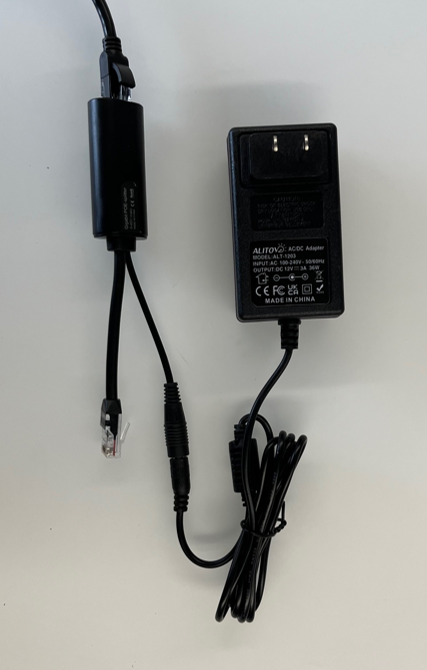
<figure><img src="/files/cBRphdOuv1xG0uNK4bML" alt=""><figcaption><p>If your boat or other platform has AC power, a "wall wart" power supply (24 VDC recommended) can be used to power the ROVLe. The cable in the upper left corner goes to the ROVLe. The cable on the left side pointed down goes to the topside network.  </p></figcaption></figure>

<figure><img src="/files/9lfLWUTrc1K6ahElUIF0" alt=""><figcaption><p>If you don't have AC power available, a battery can be used, either your boat's 12 or 24 volt system (not shown), or a stand-alone battery. In this image, the cable exiting the top goes to the ROVLe. The connector pointed down goes to the topside network.</p></figcaption></figure>

<figure><img src="/files/zasLrb8kN83KevxWBjJ3" alt=""><figcaption><p>This is a standard commercial 24V POE injector. The black cable connects to the ROVLe. The blue cable connects to the topside network. This unit plugs into 120V or 240V AC power.</p></figcaption></figure>


---

# Agent Instructions: Querying This Documentation

If you need additional information that is not directly available in this page, you can query the documentation dynamically by asking a question.

Perform an HTTP GET request on the current page URL with the `ask` query parameter:

```
GET https://docs.ceruleansonar.com/c/ethernet-rov-locator/connecting-and-powering-your-rovle-ethernet-receiver-or-transceiver/example-diy-power-injectors.md?ask=<question>
```

The question should be specific, self-contained, and written in natural language.
The response will contain a direct answer to the question and relevant excerpts and sources from the documentation.

Use this mechanism when the answer is not explicitly present in the current page, you need clarification or additional context, or you want to retrieve related documentation sections.
